
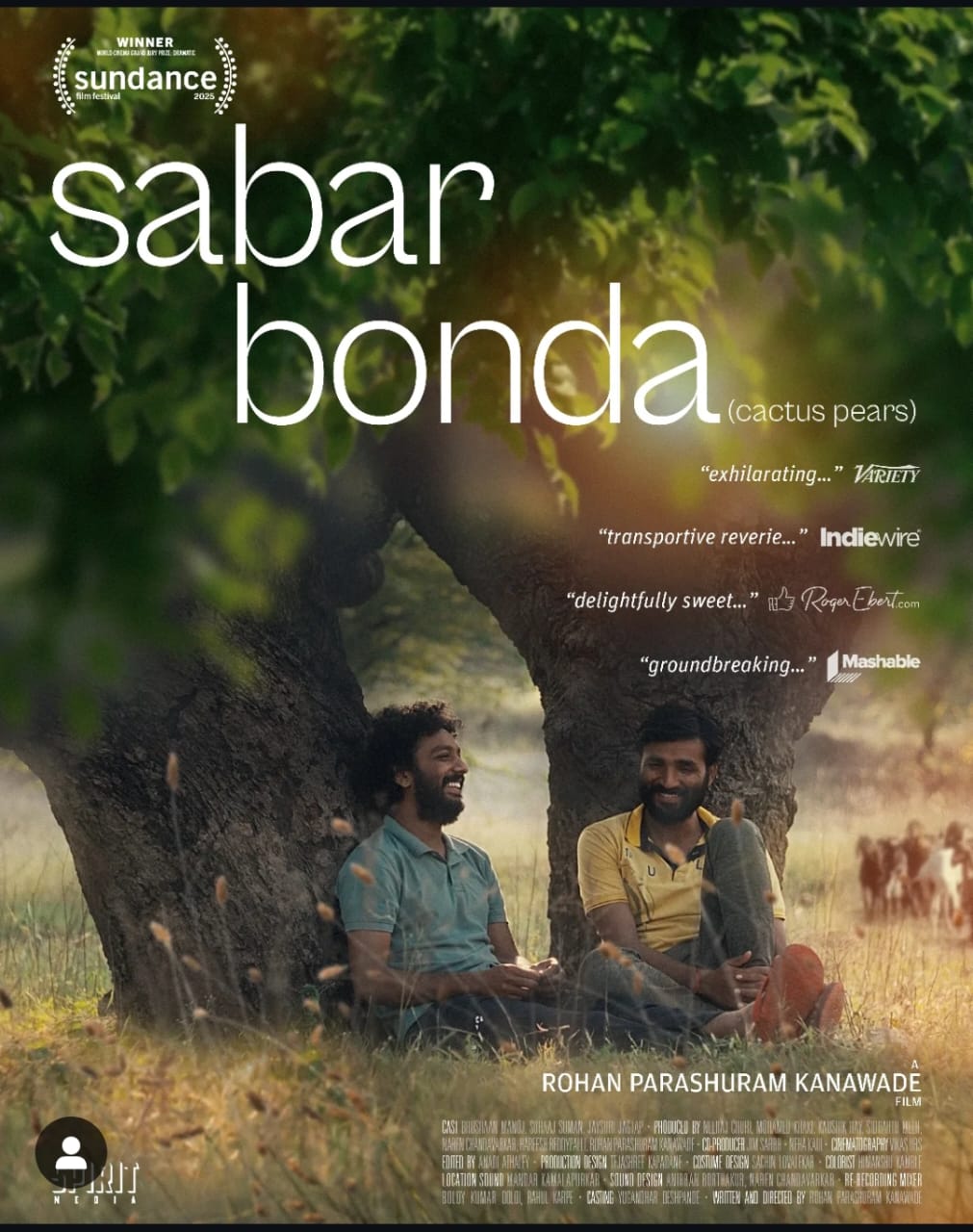

Sābar Bonḍa – Cactus Pears (India, 2025)
Director & Writer: Rohan Kanawade
Cast: Bhushan Manoj, Suraaj Suman, Jayshri Jagtap
Set in Sangamner zilla in Ahmednagar district, Maharashtra—”in the country of India, in the continent of Asia,” as one little girl in the film charmingly puts it—Sābar Bonḍa (Cactus Pears) is a tender, understated meditation on queer love in unforgiving spaces. In the same breath as Brokeback Mountain (US), Fremde Haut (Europe), or The Wound (Africa), Rohan Kanawade’s first feature-length film speaks a universal, continent-agnostic language of longing and restraint, embedded deeply in the cultural and geographic specifics of rural India.
Kanawade’s mastery lies in his treatment of space—physical, emotional, and psychological. From the black-and-white claustrophobia of Ektya Bhinti (Lonely Walls, 2012) to the chawl-life intimacy of Sundar (Beautiful, 2015), the quiet suffocation in Khidkee (Window, 2017), and the gentle meandering of U Ushacha (U for Usha, 2019), Rohan has steadily built a unique grammar. Sābar Bonḍa is his most expansive canvas yet, allowing him to fully immerse us in the rhythms of rural life and the spoken and unspoken codes of community living.
Despite being unmistakably queer, Kanawade’s films resist the pull of identity politics or overt messaging. Instead, he offers something more elusive and more truthful—the lived queer experience. His characters are never reduced to their sexuality. Rather, they are shaped by the complex interplay of tradition, religion, caste, economy, and geography. Their queerness permeates them and is not a post-it stuck to their foreheads.
Using the rituals following a death as a narrative scaffold, Sābar Bonḍa allows us intimate glimpses into lives lived under the weight of millennia-old traditions. These are people navigating the deep cultural canyon of a civilizational psyche—a canyon carved slowly, purposefully, by a river of philosophy, of belief in karma. In this terrain, queer people often find themselves at the bottom, gazing skyward, searching for footholds on walls made of stone and silence.
Urban migration, then, becomes both escape and exile. The city offers anonymity and potential freedom, but at the cost of dignity, space, and community. Kanawade captures the antecedents to this painful transition with an unhurried pace and visual restraint. Tight frames isolate characters; love is stifled before it can be expressed; fear of discovery hangs thick. His protagonists are like buoys in a sea of familial affection—loved, yet never fully seen. They drift, yet remain anchored.
Stylistically, the film evokes the quiet radicalism of Abbas Kiarostami. Static cameras, non-professional actors, an elliptical structure, and a refusal to conform to narrative expectations—all of it points to a filmmaker deeply in tune with cinema-as-philosophy. Kanawade doesn’t explain, he suggests. He doesn’t shout, he listens. And in that listening, Sābar Bonḍa becomes an act of quiet revolution.
If you’re a gay man from India, stop everything and go watch this film. You will see yourself here—in the silences, the yearning, the bruised knees from climbing invisible canyon walls. If you’re not queer, this film is your invitation to understand the quieter, deeper dimensions of Indian queer life—beyond rainbow flags and hashtags. This is the truth of queer love everywhere: persistent, tender, invisible, and yet indestructibly alive.


 Gay Bombay
Leave a comment